
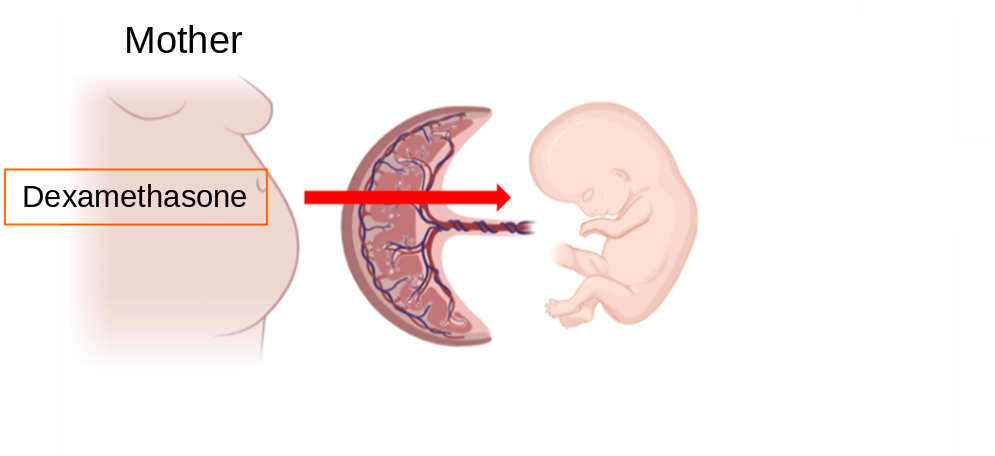
In female fetuses with classic congenital adrenal hyperplasia (CAH), the adrenal glands already produce increased amounts of androgens, the so-called male sex hormones, during pregnancy. This can lead to virilization (masculinization) of the external genitalia. To prevent this, dexamethasone therapy of the pregnant mother has been used successfully for more than 40 years. However, the treatment has not yet been studied in large clinical trials. Scientifically sound data on the optimal dosage and on the safety of the treatment for mother and child are therefore lacking. The therapy is still considered experimental and, according to the guidelines, should only be used within clinical trials at specialized centers.
Pharmacological calculations carried out ahead of the study have shown that a lower dose of dexamethasone is likely to be sufficient to achieve the necessary effect in the affected female fetus. At the same time, a lower dose could be associated with fewer potential side effects for mother and child.
The PREDICT study (PREnatal Dexamethasone in Congenital adrenal hyperplasia Therapy; EUCT No.: 2024-511702-23-00) is therefore the first to investigate whether a lower dose of dexamethasone based on these calculations is just as effective in preventing virilization of the external genitalia in affected girls as the higher dose used to date. The safety of the treatment for mother and child is being examined at the same time. The PREDICT study aims to help make prenatal dexamethasone therapy safer and more targeted in the future. The study is funded by the German Federal Ministry of Research, Technology and Space (BMFTR).
Who can take part in the study?
The study is aimed at pregnant women whose unborn child is at risk of classic CAH. A prerequisite is that both parents carry a disease-causing variant in the CYP21A2 gene.
It is particularly important to get in touch very early, as treatment must begin before the 8th week of pregnancy (before 7+6 weeks of gestation), counted from the first day of the last menstrual period.
Pregnant women from all over Germany, Austria and German-speaking Switzerland can be enrolled through the study centers in Munich and Berlin. Travel costs to Munich or Berlin are covered, and taking part in the study is free of charge. Not all study visits have to take place on site. If necessary, most of them can also be carried out close to home, at home or by telephone.
If you would like to find out more about the study, for example because you are planning another pregnancy and a future child would be at risk of classic CAH, or if you are in early pregnancy and at risk of CAH, please feel free to contact one of the study centers directly at any time:
Contact details of the study centers:
LMU University Hospital Munich
Prof. Dr. med. Nicole Reisch
Ziemssenstraße 5, 80336 Munich, Germany
Email:
MED4.Endo-Studien@med.uni-muenchen.de
nicole.reisch@med.uni-muenchen.de
Phone: +49 89 4400 52101
Charité – Universitätsmedizin Berlin
Dr. med. Uta Neumann
Augustenburger Platz 1, 13353 Berlin, Germany